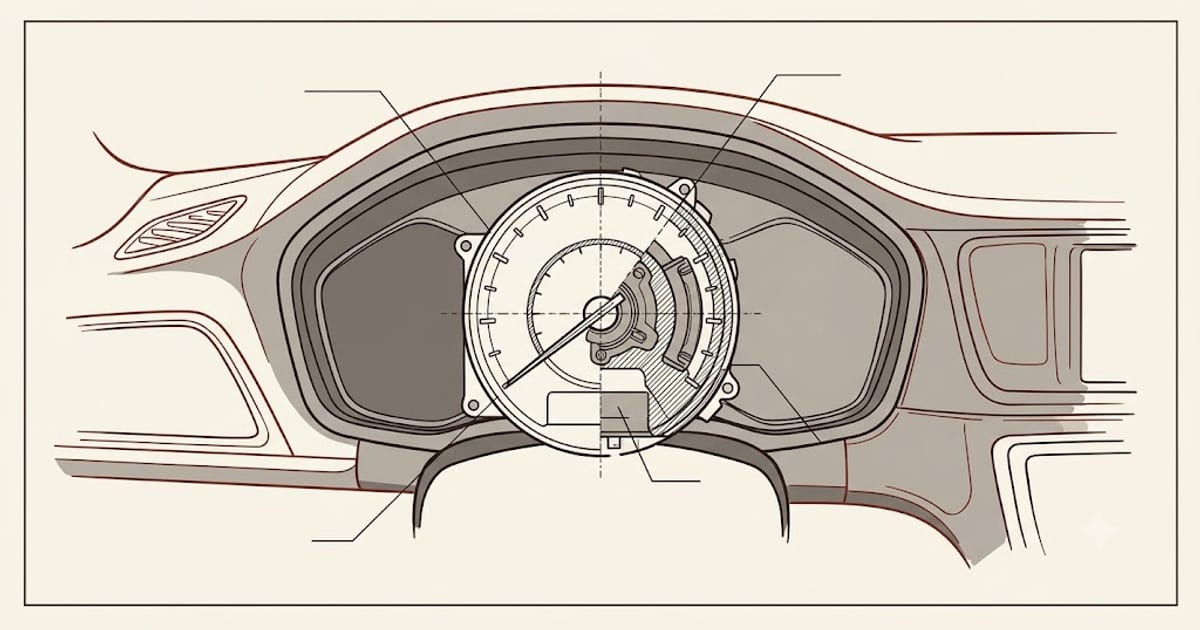
Changing tire diameter changes how far the vehicle travels per wheel rotation. The vehicle keeps multiplying rotations by the figure it was programmed with, so both speedometer and odometer drift by the same percentage.
Bigger tires read low. Smaller tires read high. The arithmetic is in how tire size changes your speedometer.
Four ways to correct it
1. Dealer service tool. On most vehicles from roughly the last two decades, tire size is a parameter in the body or powertrain module. A dealer changes it in minutes. This is the cleanest route and it corrects the odometer at the same time, since both derive from one calculation.
Not universal — some manufacturers only expose sizes they offered from the factory, which does not help if you have gone well outside that range.
2. Aftermarket programmer. A handheld device that writes the same parameter, sold widely for trucks and Jeeps where large tire changes are common. Usually also allows axle ratio changes, which matters if you re-geared at the same time.
Check it supports your exact year and model before buying. Support tables are specific and they matter.
3. Speedometer drive gear. On older vehicles with a mechanical or early electronic drive, the ratio is set by a physical gear in the transmission. Swapping it to a different tooth count corrects the reading. Cheap, permanent, and requires getting under the vehicle.
4. Inline correction module. A device wired between the speed sensor and the cluster that scales the signal. A workaround rather than a fix — it corrects the display without correcting what the vehicle's other systems receive, which is the wrong end of the problem if stability control and transmission shift points are also reading that signal.
Verify with GPS
Do not assume it worked. GPS speed is derived from position over time and is entirely independent of your wheels, which makes it the right reference.
Drive at a steady indicated 60 mph on a flat, straight road and compare with a GPS speed readout. Repeat at 30 and at 70 — errors are proportional, so a correct calibration matches at every speed while a partial correction diverges as speed rises.
Do it on level ground. On a gradient, GPS reports speed along the ground path while the speedometer reports wheel speed, and they legitimately differ slightly.
Odometer error is not retroactive
Recalibration fixes readings from that point forward. Miles already accumulated incorrectly stay incorrect.
If the vehicle ran on oversized tires for 20,000 recorded miles at 6% error, roughly 1,200 real miles were never counted and never will be. Worth a note in the service records, particularly before a sale.
When not to bother
If the change is inside about 3%, most people leave it. That is roughly the industry tolerance, error is within a couple of miles per hour at highway speed, and the systems reading wheel speed remain inside their design assumptions.
Correctly executed plus sizing lands well inside that band by design — see the plus sizing chart. Correction is for genuine diameter changes: taller off-road tires, a smaller winter setup, or a re-gear.
FAQ
Can a speedometer be recalibrated for larger tires?
On most modern vehicles, yes — tire size is a stored parameter changed with a dealer tool or an aftermarket programmer. Older vehicles may need a different speedometer drive gear.
Does recalibrating fix the odometer too?
Yes, going forward, because both readings come from the same calculation. Miles already recorded incorrectly are not corrected.
How do I check my speedometer is accurate?
Compare with a GPS speed readout at a steady speed on level ground. Check at several speeds, since errors are proportional.
Do I need to recalibrate for a 3% tire size change?
Usually not. That is roughly the industry tolerance and the error amounts to a couple of miles per hour at highway speed.
Is an inline speedometer correction box a good solution?
It corrects the display but not the signal reaching other systems that read wheel speed. Prefer changing the stored tire size parameter where that is possible.