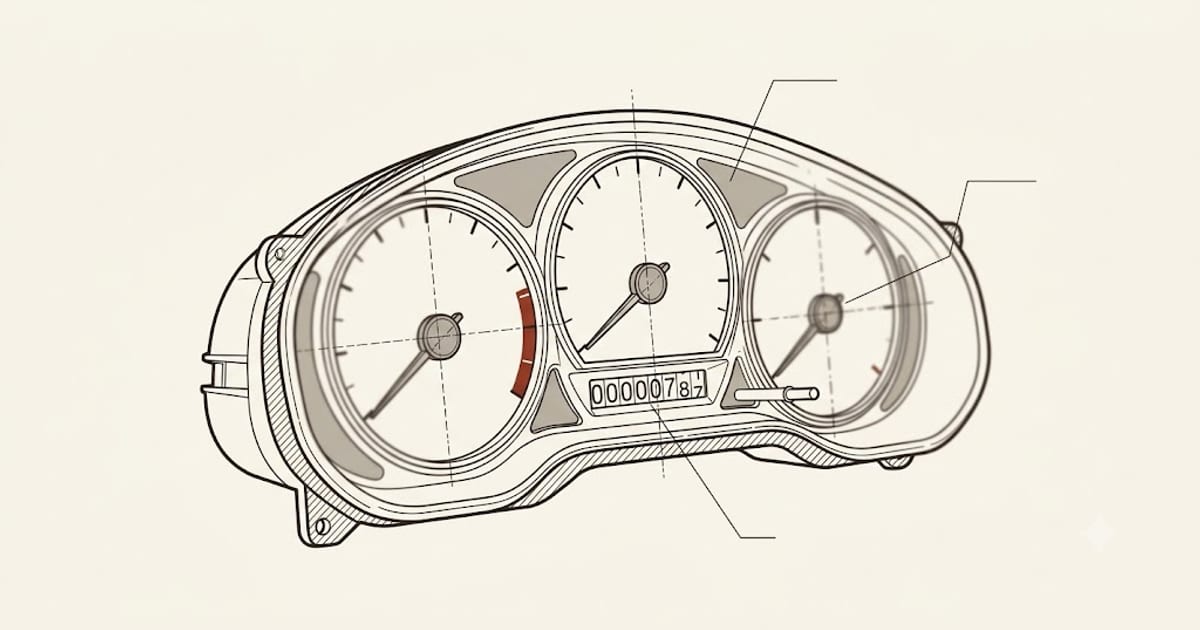
Yes, and by exactly the same percentage as the speedometer.
Both readings come from the same source: the vehicle counts wheel rotations and multiplies by the circumference it was programmed to expect. Change the tire and you change the real distance per rotation, but not the number the computer multiplies by.
Bigger tires travel further per rotation, so the odometer under-counts. You have driven more miles than it shows.
The arithmetic
error % = (new diameter − old diameter) ÷ old diameter × 100
Going from a 29.0 in tire to a 31.0 in tire:
(31.0 − 29.0) ÷ 29.0 = 6.9% under-reading
Every 1,000 miles the odometer records, you have actually driven 1,069. Over 60,000 recorded miles, that is more than 4,100 real miles the vehicle has covered and the odometer never counted.
Where it costs money
Warranty. Coverage ends at a stated mileage. If the odometer under-reads, the real distance at that point is higher — you have consumed more of the vehicle's life for the same recorded number. The warranty is unaffected in your favour, which sounds like a benefit, but the wear is real even when the number is not.
Service intervals. An oil change due every 7,500 recorded miles arrives at 8,000 real miles at 6.9% error. The oil does not know what the display says.
Lease mileage. This one cuts the other way and it is worth knowing: a leased vehicle with oversized tires records fewer miles than it travelled. Whether the leasing company treats that as a defect is a question for the contract, not for this page.
Resale. A vehicle whose odometer under-reads shows fewer miles than it has done. Buyers and inspectors do look at tire size against the placard.
The reverse case
Smaller tires produce the opposite error: the odometer over-counts, and the speedometer reads higher than actual speed. Winter setups are the common case, since winter tires are often fitted in a smaller diameter on smaller wheels.
If your winter tires are correctly plus-minus sized to keep overall diameter the same, there is no error at all — which is the entire reason that convention exists. See plus sizing.
The 3% convention
The industry works to roughly 3% as the acceptable deviation in overall diameter when changing size. Inside that band, speedometer error stays within most regulatory tolerances and other systems behave normally.
The convention exists because the wheel speed signal feeds more than the two gauges. ABS, stability control, traction control, transmission shift points, cruise control and on some vehicles the tire pressure monitoring system all read the same source. Large deviations do not just misreport — they change how those systems behave.
Details on the full list in how tire size changes your speedometer.
Can it be corrected?
Sometimes. Many vehicles allow the tire size parameter to be recalibrated, either through a dealer tool or an aftermarket programmer. When available, this corrects speedometer and odometer together because they share the calculation.
Where recalibration is not available, the error is permanent for as long as those tires are fitted. Keeping a note of the percentage and the date of the change is the practical minimum — it lets you reconstruct real mileage later, which matters most at resale.
FAQ
Do bigger tires make the odometer read low?
Yes. Bigger tires cover more ground per rotation, so the vehicle counts fewer miles than it travelled — by the same percentage as the speedometer error.
How much does a 2-inch larger tire affect the odometer?
Going from 29 to 31 inches is about 6.9%. Over 60,000 recorded miles that is roughly 4,100 uncounted miles.
Does it affect the warranty?
Not in your disfavour — the recorded mileage is lower than actual, so warranty coverage lasts slightly longer in real distance. The wear is still real.
Can the odometer be recalibrated for tire size?
On many vehicles, yes, through a dealer tool or aftermarket programmer. It corrects the speedometer at the same time, since both use the same calculation.
Do smaller tires make the odometer read high?
Yes, the reverse of the same effect. This is common with winter setups unless the winter size was chosen to keep the overall diameter the same.