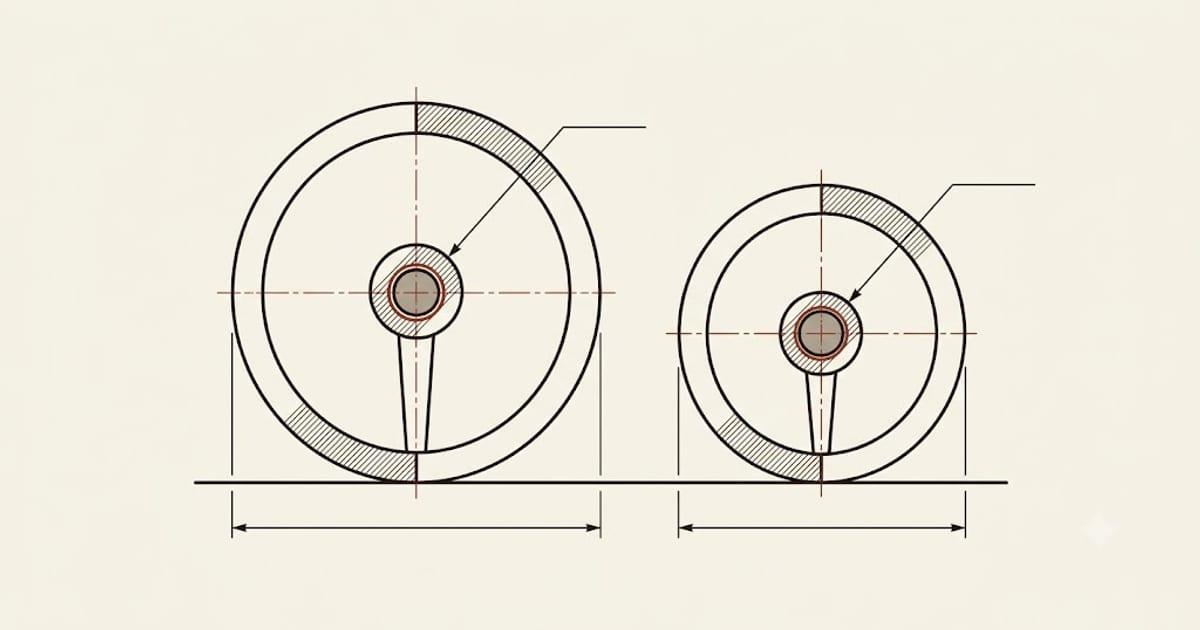
A speedometer does not measure speed. It counts wheel rotations and multiplies by a distance-per-rotation figure fixed at the factory.
Change the rolling diameter and every rotation covers a different distance, so the displayed speed is wrong by exactly that percentage.
error % = (new diameter − old diameter) ÷ old diameter × 100
A taller tire under-reads: the wheel turns fewer times for the same distance, so the display shows less than actual speed. A shorter tire over-reads.
An example
Stock 225/60R16 → 27.6 in diameter. Fitted 235/65R16 → 28.0 in.
(28.0 − 27.6) ÷ 27.6 = +1.4%. At an indicated 70 mph you are doing 71. Nobody will notice, and nothing needs recalibrating.
Fit 245/75R16 → 30.5 in, and the error is +10.5%. Indicated 70 is an actual 77.4 — enough to matter to a traffic officer, and enough to put the odometer 10% under for the rest of the vehicle's life.
The 3% rule
The tire industry works to ±3% of the original rolling diameter. Inside that window:
- The speedometer error is below what most gauges display anyway
- ABS and stability control tolerate it
- Transmission shift points are unaffected
- Odometer drift is within the meter's own tolerance
Outside it, several things start to need attention. Beyond about 5% it is worth recalibrating; beyond 10% it is not optional.
What else reads off diameter
Odometer. Under-reads with taller tires, which quietly extends every service interval and inflates the vehicle's apparent remaining value. Over a decade a 5% error hides 7,500 miles on a 150,000-mile car.
ABS and traction control. These compare wheel speeds. Uniform error across all four is tolerated; mismatched tires front to rear are not, and that is a fault light rather than an inaccuracy.
Transmission shift schedule. Many automatics shift on vehicle speed. A large under-read makes the transmission shift late, which shows as a car that feels lazy and runs hotter.
Cruise control holds the wrong speed, by the same percentage.
Tire pressure monitoring learns rotation rates on some indirect systems and can throw false warnings after a size change.
Adaptive cruise and lane keeping on newer vehicles use wheel speed for sensor fusion. Manufacturers are increasingly explicit that these need recalibration after a size change.
Recalibrating
Most vehicles since the mid-2000s can be recalibrated by a dealer or with a handheld programmer, by entering the new tire size or the axle ratio. Older vehicles with a mechanical drive need a different speedometer gear.
Work out the exact error for your two sizes on the speedometer calculator before deciding whether it is worth doing.