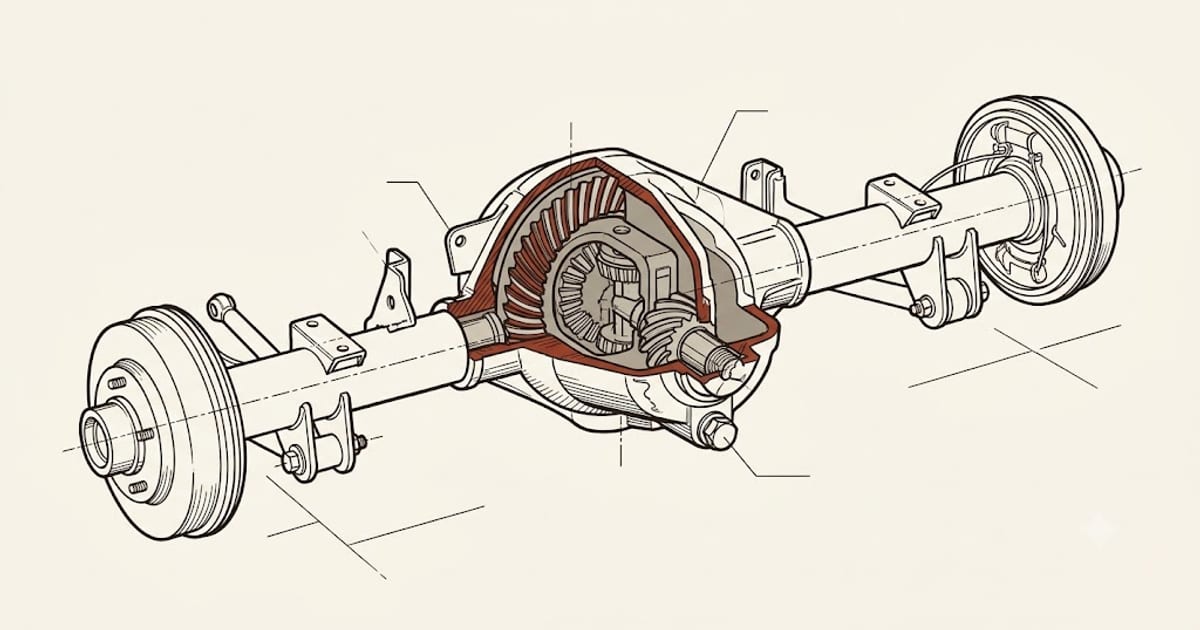
Effective gearing is the axle ratio combined with tire diameter. Change either and the vehicle behaves as though you changed the other.
A larger tire travels further per revolution, so the engine turns fewer times per mile. That is precisely what a taller axle ratio does.
The arithmetic
new effective ratio = old ratio × (old diameter ÷ new diameter)
A truck with 3.73 gears on 31-inch tires, moving to 33s:
3.73 × (31 ÷ 33) = 3.50
The differential was never touched, and the vehicle now behaves as though it has 3.50 gears. That is a full step of gearing, given away.
What that costs
Taller effective gearing means:
- Slower acceleration. Less torque multiplication at the wheels.
- Worse towing. The engine works harder at lower rpm, and transmissions hunt between gears on grades.
- Higher transmission temperatures when loaded, because of that hunting and the added strain.
- Lower cruising rpm, which is the one benefit — sometimes better highway economy, though the added weight and rolling resistance of bigger tires often cancels it.
On a naturally aspirated engine with modest torque, the loss is obvious from the first drive. On a torque-rich turbodiesel, it can be barely noticeable.
Re-gearing to restore it
To get back what the tire change took, invert the ratio:
required ratio = old ratio × (new diameter ÷ old diameter)
3.73 × (33 ÷ 31) = 3.97, so a 4.10 axle is the nearest common option.
Available ratios come in steps, so you rarely land exactly. Standard practice is to round up — slightly deeper gearing than the calculation gives — because most people who fit larger tires also added weight, and weight wants gearing too.
| Tire change | Compensating ratio, from 3.73 |
|---|---|
| 31 → 33 in | 3.97 → fit 4.10 |
| 31 → 35 in | 4.21 → fit 4.30 |
| 33 → 35 in | 3.96 → fit 4.10 |
| 31 → 37 in | 4.45 → fit 4.56 |
Re-gearing means both differentials on a four-wheel-drive vehicle. Doing one is not an option — front and rear must match, and a mismatch destroys the transfer case.
Do it in the right order
If you are re-gearing at all, decide the final tire size first. Gearing for 33s and later moving to 37s means paying for the job twice.
And recalibrate the speedometer afterwards. A programmer that sets axle ratio usually sets tire size in the same session, which is the efficient way to do both — see recalibrating a speedometer.
When to leave it alone
Re-gearing is expensive and it is not always warranted:
- Diameter change under about 10% — most people live with it comfortably.
- A vehicle that never tows and rarely carries load — the loss is an annoyance rather than a problem.
- Plenty of low-end torque — turbodiesels and large-displacement engines absorb a step of gearing more gracefully.
The cases that genuinely need it are towing, heavy off-road use, and tire increases past roughly 15%, where the vehicle starts feeling permanently under-geared rather than merely relaxed.
FAQ
Do bigger tires change gearing?
Effectively yes. A larger tire travels further per revolution, which acts exactly like a taller axle ratio.
What gears do I need for 33-inch tires?
From 3.73 on 31s, the calculation gives 3.97 — so 4.10 is the usual choice. It depends on your starting ratio and original tire size.
How do I calculate the effective ratio change?
Multiply the old ratio by old diameter divided by new diameter.
Do I need to re-gear both axles?
On four-wheel drive, yes. Front and rear ratios must match or the transfer case is damaged.
Is re-gearing always necessary with bigger tires?
No. Under about 10% diameter increase most people leave it, particularly on engines with strong low-end torque and vehicles that do not tow.