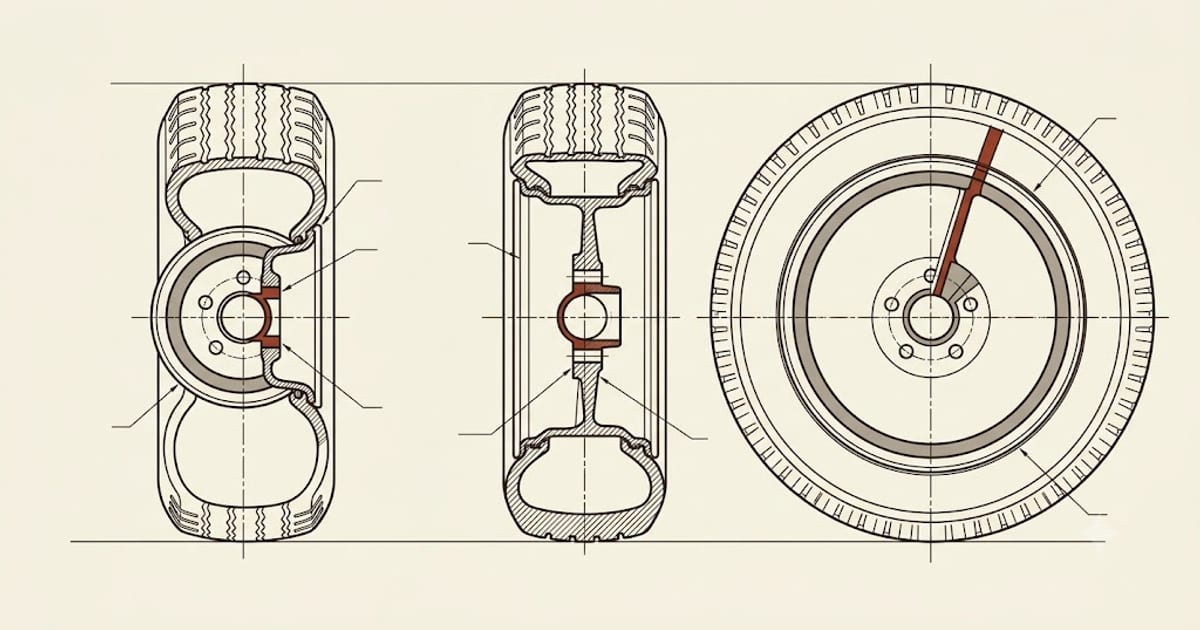
Plus sizing fits a larger-diameter wheel while keeping overall tire diameter unchanged. Larger rim, shorter sidewall, usually wider tread.
The rule: for each inch added to the rim, add about 20 mm of section width and drop the aspect ratio by about 10 points.
| Step | Size | Diameter |
|---|---|---|
| Stock | 205/65R15 | 25.5 in |
| Plus 1 | 225/55R16 | 25.7 in |
| Plus 2 | 245/45R17 | 25.7 in |
| Plus 3 | 245/40R18 | 25.7 in |
Every step stays within about 1% of stock. That is the whole discipline.
Why diameter has to stay
Everything downstream reads off rolling diameter: speedometer, odometer, ABS, stability control, transmission shift points, cruise control. Keep it within 3% and none of them need attention.
Plus sizing that changes diameter is not plus sizing. It is a diameter change with a wheel change attached, and it has all the recalibration consequences.
What you gain
Steering response. A shorter sidewall flexes less, so steering inputs reach the contact patch with less delay. This is the real handling benefit and it is immediately noticeable.
Cornering grip, from the wider tread and stiffer sidewall.
Appearance, which is honestly the main reason most plus sizing happens.
What you lose
Ride quality. The sidewall is the primary suspension element for small impacts. Halving sidewall height roughly doubles the harshness of expansion joints and small potholes. There is no damper setting that recovers it.
Pothole survival. Less sidewall means less to absorb an impact before the rim takes it. Bent rims and sidewall bubbles rise sharply from plus 2 onward, and low-profile tires are more expensive to replace.
Unsprung weight. A larger wheel is heavier than the rubber it displaces, usually by 3 to 8 lb per corner. That hurts ride, acceleration and braking slightly, and it is one of the few modifications that makes a car objectively worse in more ways than it improves.
Cost. Low-profile tires in large sizes cost substantially more and generally wear faster.
Winter performance falls with a wider, lower-profile tire — narrower is better in snow, which is why winter setups often go the other way.
Minus sizing
The reverse, and it is the sensible move for a winter set: smaller wheel, taller sidewall, narrower tread. Better snow performance, more sidewall to survive potholes hidden under slush, and cheaper tires.
Run the exact diameters and the resulting speedometer error for any two sizes on the plus sizing calculator before ordering.