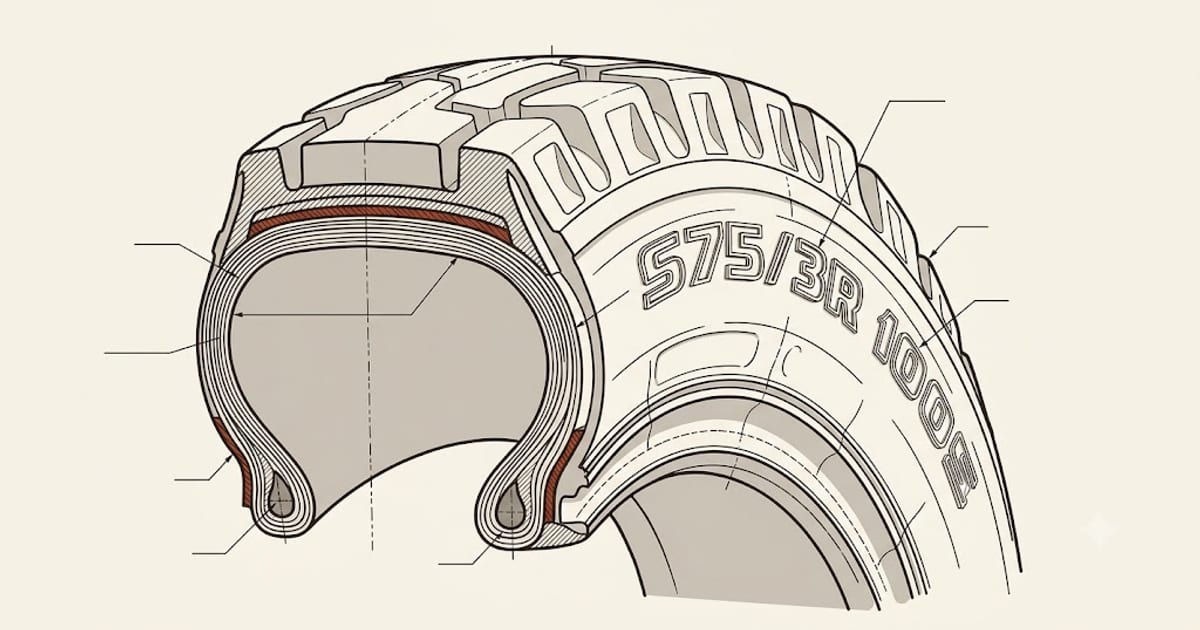
The two characters after the size are the service description: a load index and a speed rating.
In 225/45R17 94V, the 94 is the load index and V is the speed rating. Neither is a measurement — both are codes into a published table.
The load index table
The index is not linear and the steps are not even, which is exactly why it cannot be estimated:
| Index | kg | lb | Index | kg | lb |
|---|---|---|---|---|---|
| 82 | 475 | 1,047 | 100 | 800 | 1,764 |
| 85 | 515 | 1,135 | 103 | 875 | 1,929 |
| 87 | 545 | 1,201 | 105 | 925 | 2,039 |
| 91 | 615 | 1,356 | 108 | 1,000 | 2,205 |
| 94 | 670 | 1,477 | 110 | 1,060 | 2,337 |
| 95 | 690 | 1,521 | 115 | 1,215 | 2,679 |
| 97 | 730 | 1,609 | 118 | 1,320 | 2,910 |
| 99 | 775 | 1,709 | 121 | 1,450 | 3,197 |
Each figure is the maximum load one tire may carry at its maximum rated pressure.
Four tires do not add up to your car
This is the part that gets misread. Four tires at index 94 carry 4 × 1,477 = 5,908 lb, and almost no car weighs that. It is tempting to conclude there is enormous margin.
There is not, for three reasons.
Load is never distributed evenly. Front-engined cars carry substantially more weight on the front axle. In a corner, weight transfers outward — briefly, one tire may be carrying far more than a quarter of the vehicle.
The rating assumes maximum pressure. The load index is the capacity at the tire's maximum rated inflation, not at the pressure on your door placard. Run lower pressure and the real capacity is lower too.
The figure is a limit, not an operating point. Sustained running near a component's maximum rating is how components fail, and a tire failure at speed is not a gradual one.
The placard on the driver's door jamb already accounts for all of this. It is the number to match.
Speed ratings
| Letter | mph | km/h |
|---|---|---|
| Q | 99 | 160 |
| S | 112 | 180 |
| T | 118 | 190 |
| H | 130 | 210 |
| V | 149 | 240 |
| W | 168 | 270 |
| Y | 186 | 300 |
The speed rating is not advice about how fast to drive. It certifies the tire's ability to shed heat at sustained speed, and heat is what destroys tires. A tire rated well below the original may run hotter in ordinary use, not only at the top of its range.
Winter tires are a recognised exception: many carry a lower speed rating than the original fitment, and this is accepted practice provided the driver knows the limit.
XL, Reinforced, and load range
XL or Reinforced means a stronger casing that carries more load at a higher maximum pressure. An XL tire has a higher load index than the standard version of the same size — they are not interchangeable, and fitting a standard tire where XL was specified reduces capacity.
Load range letters (C, D, E) appear on light truck tires and correspond to the old ply ratings — C is roughly 6-ply equivalent, D is 8, E is 10. They describe casing strength rather than an exact load figure, and the numeric index still applies.
The rule
Never fit a load index lower than the placard. Higher is acceptable and sometimes unavoidable; lower is not, and on many vehicles it fails inspection.
For speed rating the same principle applies with a documented winter exception. When changing tire size, load index changes with it — see will these tires fit for the other checks that come with it.
FAQ
What does 94V mean on a tire?
Load index 94, which is 1,477 lb per tire, and speed rating V, which is 149 mph.
Can I use a tire with a higher load index?
Yes. Higher is always acceptable. The ride may be marginally firmer because the casing is stiffer.
Can I use a lower load index?
No. It reduces the vehicle's rated capacity below what the manufacturer specified, and it fails inspection in many jurisdictions.
Do four tires add up to the vehicle weight limit?
No. Load transfers between axles and between sides, and the rating assumes maximum inflation pressure. Match the door placard rather than doing the arithmetic.
What does XL mean on a tire?
Extra Load — a reinforced casing with a higher load index and higher maximum pressure than the standard version of the same size.