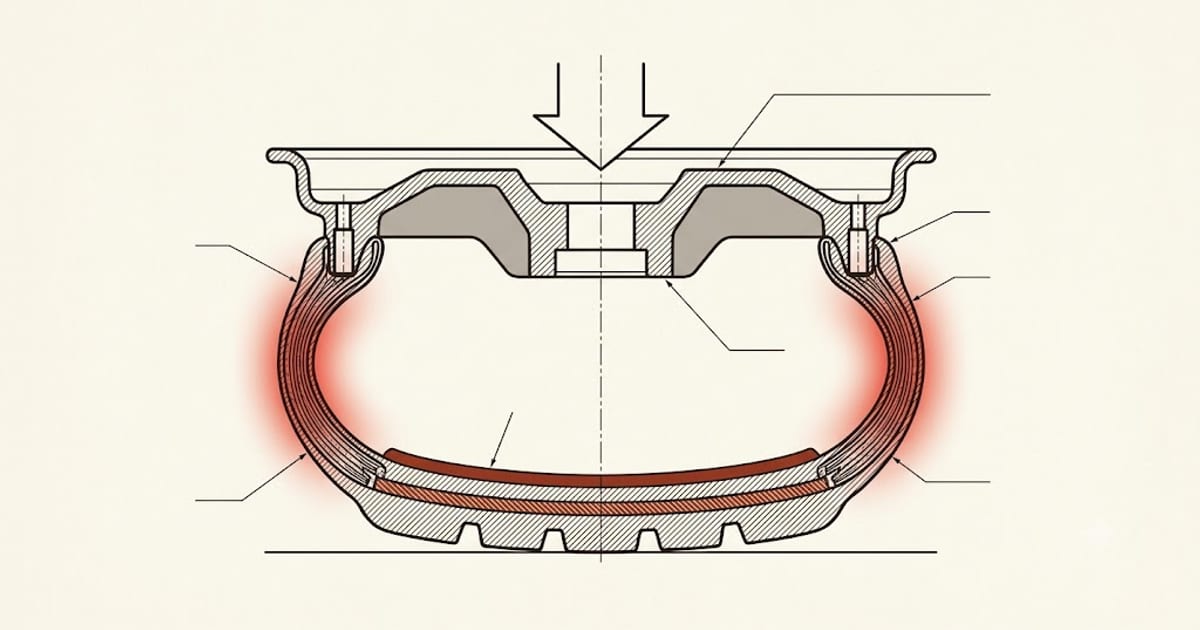
A sidewall reads something like 225/45R17 94V. The size is the first part. The 94 is the load index and the V is the speed rating, and both are safety specifications rather than capability claims.
Load index
An index, not a weight. Each number maps to a maximum load per tire at its rated pressure:
| Index | lb per tire | Index | lb per tire | |
|---|---|---|---|---|
| 85 | 1,135 | 97 | 1,609 | |
| 88 | 1,235 | 99 | 1,709 | |
| 91 | 1,356 | 101 | 1,819 | |
| 94 | 1,477 | 103 | 1,929 | |
| 95 | 1,521 | 105 | 2,039 |
The vehicle placard in the door jamb states the minimum. Meet or exceed it, always. Fitting a lower index because the tire is otherwise identical is the most common fitment error there is, and the failure mode is a sidewall that runs hot under load.
Load capacity depends on inflation pressure. The index is quoted at the tire's maximum rated pressure, and a tire run below the placard pressure carries less than its index says. This is why underinflation and heavy loads are such a dangerous combination.
Speed rating
| Letter | Max speed | Typical use |
|---|---|---|
| Q | 99 mph | Winter tires, light truck |
| S | 112 mph | Standard passenger |
| T | 118 mph | Standard passenger |
| H | 130 mph | Touring, performance |
| V | 149 mph | Performance |
| W | 168 mph | High performance |
| Y | 186 mph | High performance |
| ZR | 149+ | Marker, used with W or Y |
The rating is not about how fast you drive. It is a heat tolerance specification, verified by running the tire at speed on a test drum until it either survives or does not.
A higher rating generally means a stiffer construction and a softer compound — better steering response and grip, and usually shorter tread life and a harder ride. That is the real trade, not top speed.
Lowering either one
Load index: never. There is no acceptable case on a passenger vehicle.
Speed rating: sometimes justifiable. Winter tires are commonly rated lower than the summer tires they replace, and that is normal and accepted — many manufacturers state it explicitly. But it is a deliberate seasonal decision, and the vehicle's handbook may require a speed limiter sticker.
Mixing ratings across an axle is not good practice, and the axle should be treated as having the lower of the two.
XL and reinforced
An XL or Reinforced marking means a higher load index at a higher maximum pressure than the standard-load version of the same size. XL tires need the higher pressure to deliver that capacity — running them at standard-load pressures gives a harsh ride and none of the extra capacity.