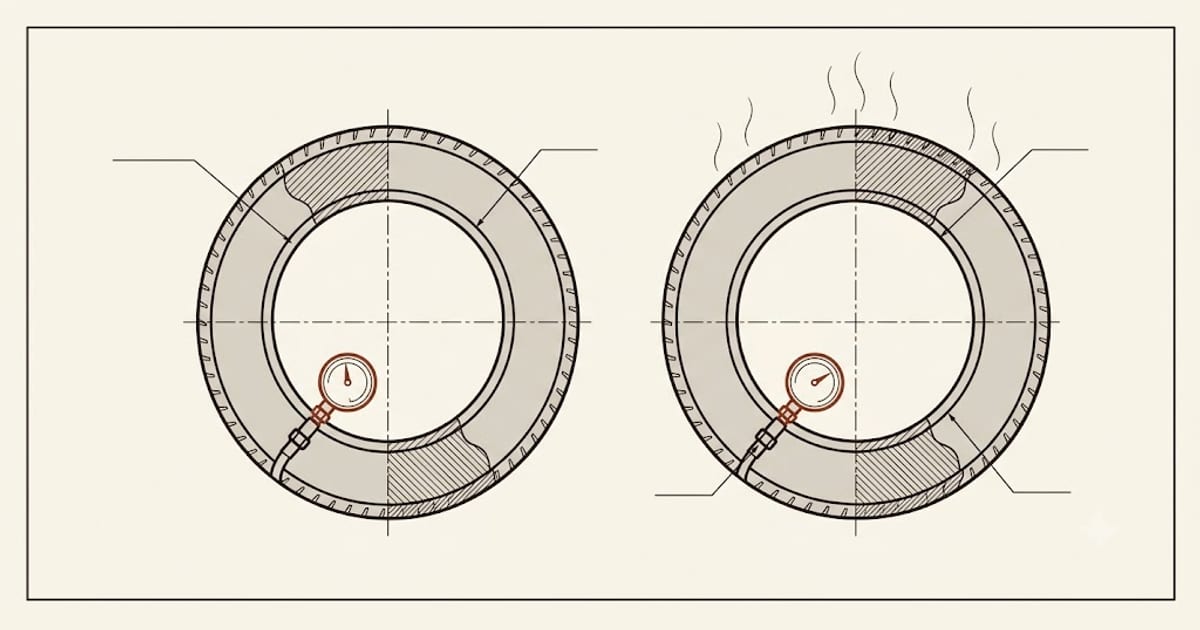
Every recommended pressure — door placard, handbook, tire manufacturer — is a cold figure. Cold means the vehicle has been stationary for at least three hours, or driven less than a mile.
Set pressure on a warm tire and it will be several psi low once it cools.
How much it moves
Driving adds roughly 2 to 6 psi within a few miles. Highway speeds, heavy loads and hot weather push toward the top of that.
Ambient temperature moves pressure about 1 psi per 10 °F (roughly 1 psi per 5.5 °C). That is why TPMS lights appear on the first cold morning of autumn: a tire set correctly in September is genuinely low in November, and nothing has leaked.
A 30 °F drop from a warm October to a cold December takes about 3 psi out of every tire.
The placard, not the sidewall
The pressure on the sidewall is the tire's maximum, tied to its maximum load rating. It is not a recommendation and using it as one is the most common pressure error there is.
The correct figure is on the door jamb placard, and it is the vehicle manufacturer's number for that vehicle's weight, weight distribution and suspension. Front and rear often differ.
Do not bleed hot tires
Letting air out of a hot tire to reach the placard figure leaves it substantially underinflated once it cools — the opposite of what was intended, and the more dangerous direction.
If you must set pressure on warm tires, add about 4 psi to the placard figure and recheck cold when you can.
TPMS
Direct systems have a pressure sensor in each wheel and report actual pressure. The warning light triggers at about 25% below placard, which is already low enough to affect handling and wear — it is a warning, not a monitor.
Indirect systems have no sensors. They infer pressure from wheel rotation speed via the ABS, because an underinflated tire has a smaller rolling radius and turns faster. They must be reset after any pressure adjustment or tire change, and they are poor at detecting uniform loss across all four tires.
Neither replaces a monthly check with a gauge.
Nitrogen
Nitrogen molecules are marginally larger than oxygen, so they diffuse through rubber slightly more slowly, and dry nitrogen carries no water vapour to expand with heat.
Both effects are real and small. Air is already 78% nitrogen. For a road car checked monthly, the benefit does not justify the cost or the inconvenience of topping up.
The spare
Full-size spares lose pressure like any other tire and are almost never checked. Compact temporary spares run at much higher pressure — often 60 psi — and are frequently found at half that when needed.