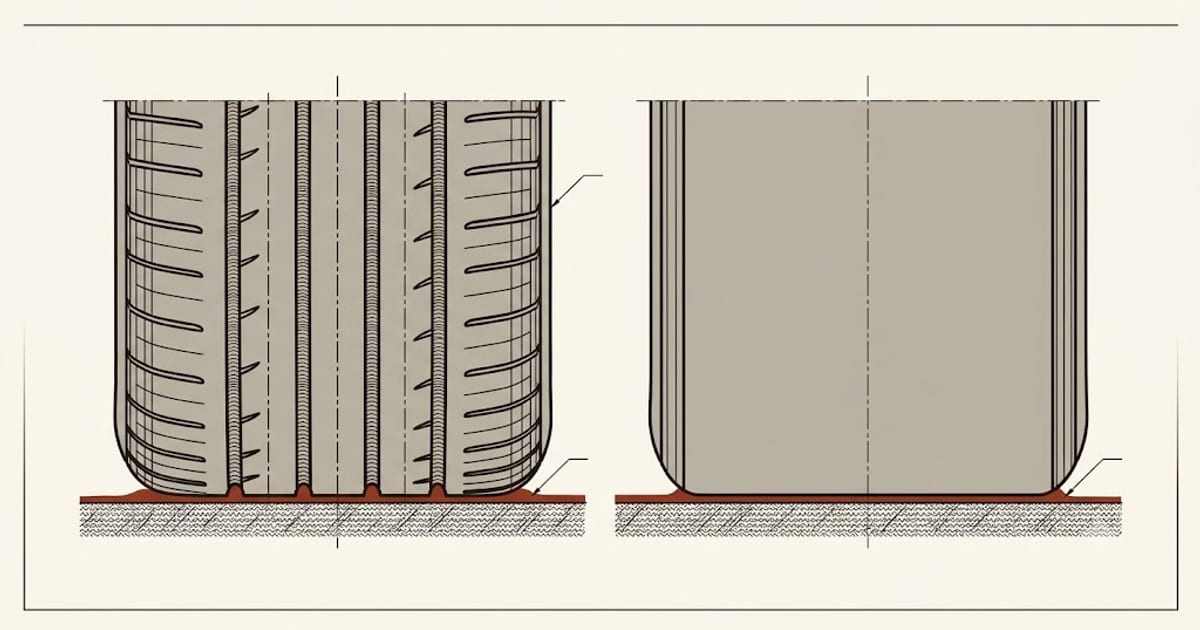
Winter tires are not "snow tires with more grooves". The primary difference is the compound, and it matters on cold dry roads as much as on snow.
The 7 °C line
Standard all-season and summer compounds stiffen as temperature drops. Below roughly 7 °C they harden enough that the contact patch stops conforming to the road surface, and grip falls off — on dry asphalt, before any snow is involved.
Winter compounds stay pliable well below freezing. That is what makes a winter tire stop shorter on a cold dry road than an all-season, and it is the part most people do not expect.
So the decision is not "does it snow here". It is "how many months are below 7 °C".
What the tread does
Winter tread adds two things:
Sipes — thousands of fine slits that open under load, giving many more biting edges and channels for the water film that forms between rubber and ice.
Higher void ratio — more open space between blocks to pack and eject snow. Snow grips snow better than rubber grips snow, so a tread that packs snow into its voids performs better than one that stays clear.
The markings
M+S is a geometric description of the tread pattern. Nearly every all-season carries it and it certifies no performance at all.
3PMSF — the three-peak mountain snowflake — requires passing a standardised snow acceleration test. It means something, and in jurisdictions with winter tire regulations it is often the marking that satisfies them.
Some all-weather tires carry 3PMSF and can be run year-round. They are a genuine middle option: worse than a dedicated winter in deep cold, better than an all-season, and they wear faster in summer.
Four, not two
Fitting winter tires to the driven axle only creates a large grip imbalance. On a front-wheel-drive car that means a front end that grips and a rear end that does not, which is how ordinary corners become spins.
All four, always. In many places it is also the law.
Studs and studless
Studless winter tires dominate now. Compound and siping have improved enough that they match or beat studs on most surfaces, and they are quieter and legal everywhere.
Studded still wins on smooth ice. They are noisy, they damage road surfaces, and they are restricted or banned in many jurisdictions and seasonally limited in others.
Storage
Off-season tires last longer stored cool, dark and dry, away from ozone sources — electric motors are the classic one. Stack unmounted tires flat, or hang mounted ones. Six to ten years of calendar life applies whether or not they are on the car.