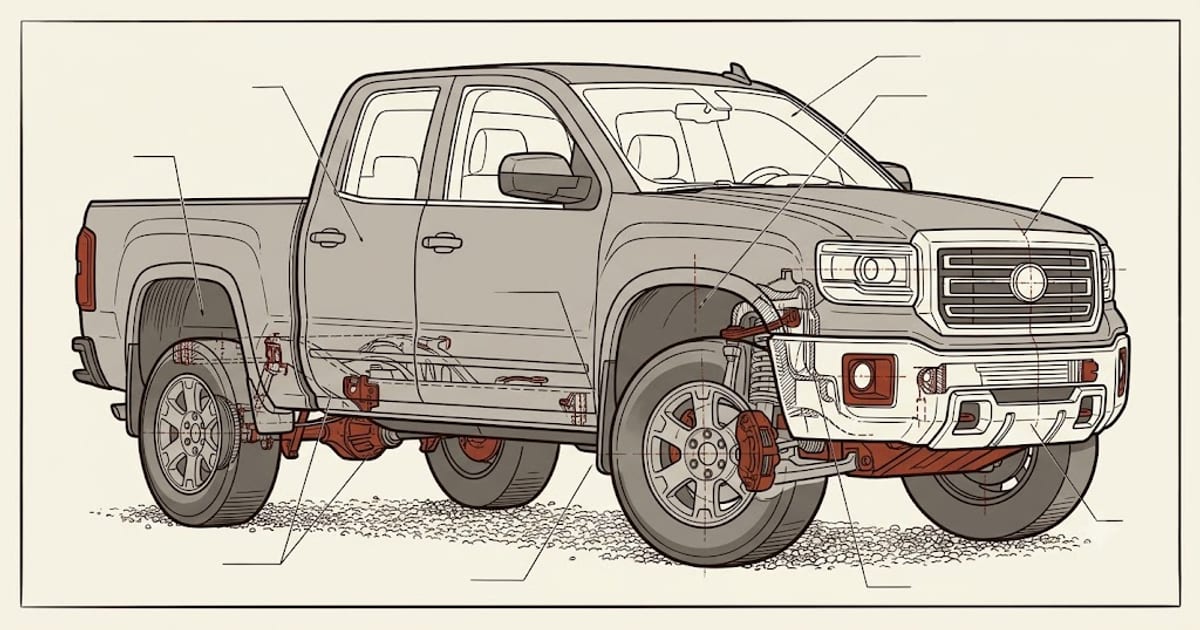
On most current half-ton trucks, a 33-inch tire clears the arch on stock suspension while driving straight. That is not the question that matters.
Rubbing happens at full steering lock combined with suspension compression — turning into a driveway, reversing into a parking space, one wheel dropping into a pothole mid-turn. Those conditions arrive rarely enough that people fit tires, drive home happily, and discover the problem a week later.
The four contact points
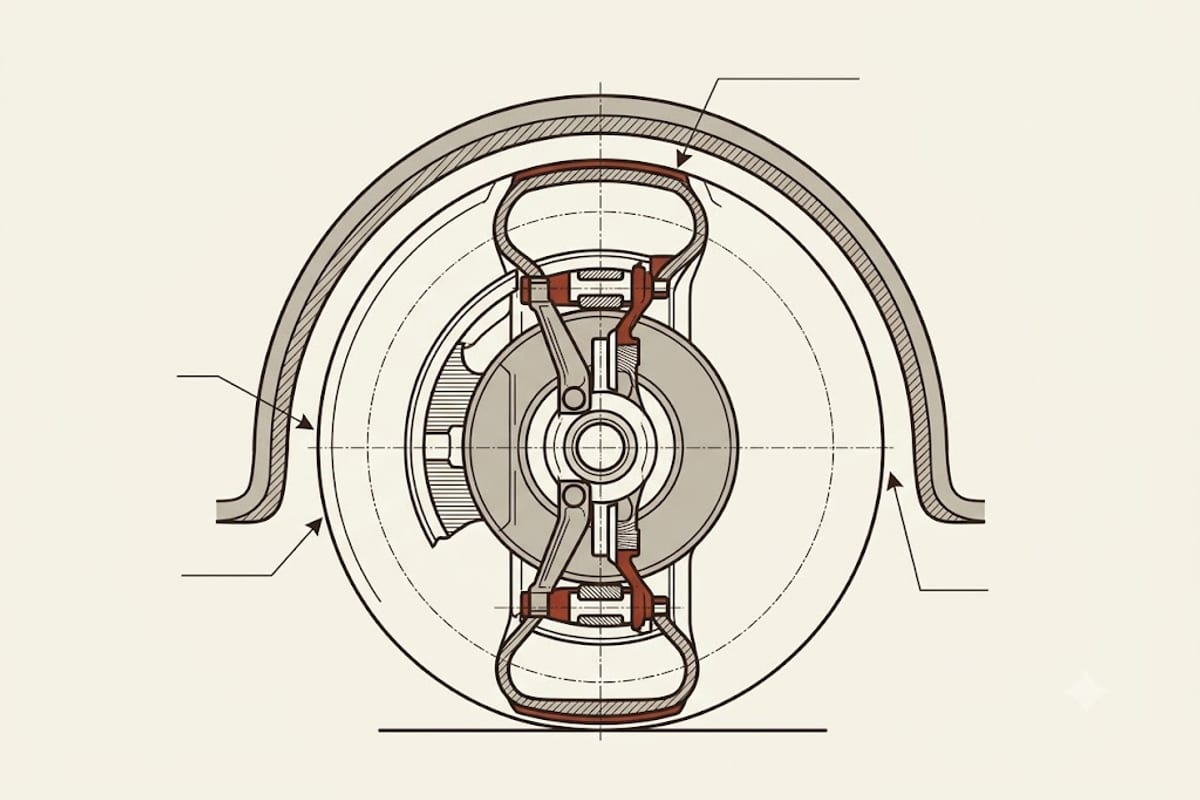
Inner suspension components. The tire's inner shoulder against control arms, sway bar links or the frame. Worst at full lock. Not fixable by trimming — this one needs different wheel offset or a smaller tire.
Front inner corner of the wheel arch. Usually plastic liner, mud flaps or an air dam. Commonly trimmed, and the most frequent "minor work" people report.
Rear inner corner of the arch. Contacted under compression rather than at lock.
Top of the arch. Only under heavy compression. Rarely the limit on a truck, more often on cars.
Backspacing decides more than tire size
Two identical tires on wheels with different backspacing sit in completely different places.
Less backspacing — the wheel moves outward. Gains inner clearance from suspension parts, loses outer clearance at the fender lip, and widens the track.
More backspacing — the wheel tucks inward. Opposite trade.
This is why the same tire fits one truck and rubs on another with identical suspension. It is also the usual solution: a wheel an inch narrower in backspacing frequently resolves inner rub without touching the suspension.
It is not free. Pushing the wheel outward increases the scrub radius, which loads wheel bearings differently and changes steering feel. A small change is unremarkable; a large one is a compromise.
Which metric sizes are 33 inches
"33s" is a flotation-size habit carried into a metric world:
| Metric | Overall diameter |
|---|---|
| 285/70R17 | ~32.7 in |
| 275/70R18 | ~33.2 in |
| 285/75R16 | ~32.8 in |
| 305/65R17 | ~32.6 in |
| 275/65R20 | ~34.1 in |
Note the spread in width at the same diameter — 275 to 305 mm. Width often limits fitment before diameter does, because width is what reaches the suspension at lock. A narrower 33 fits where a wider one does not.
The conversion arithmetic is in what is a 33-inch tire in metric.
Check before you buy, not after
- Turn the wheel to full lock, both directions, and look at the gap between the tire's inner shoulder and the nearest suspension part. That gap is your budget.
- Ask what backspacing your current wheels have. It is the number that decides whether a fitment report from someone else applies to you.
- Look for existing rub marks on the liner — a previous owner may have already found the limit.
- Search your specific model, year, trim and wheel offset. Trim level matters: off-road packages often have wider arches and more clearance than the base truck.
What changes besides clearance
Fitting 33s where 31s were is roughly a 6% diameter increase, so:
- Speedometer and odometer under-read by about 6% — see does tire size affect the odometer.
- Effective gearing gets taller; acceleration and towing suffer.
- Braking distances lengthen slightly.
- Load index changes with the size and must not fall below the placard — see the load index chart.
None of those are reasons not to do it. All of them are reasons to know before rather than after.
FAQ
Will 33-inch tires fit without a lift?
On most current half-ton trucks, yes, often with minor trimming of the liner or mud flaps. Rubbing occurs at full steering lock under compression rather than while driving straight.
What is a 33-inch tire in metric?
Common equivalents are 285/70R17, 275/70R18 and 285/75R16, all measuring roughly 32.7 to 33.2 inches overall.
Does wheel backspacing affect whether tires fit?
Substantially. Less backspacing moves the wheel outward, gaining inner clearance from suspension parts and losing it at the fender.
Why do my new tires only rub when turning?
Full steering lock brings the tire's inner shoulder close to suspension components, and compression adds to it. Driving straight tests neither condition.
Do bigger tires affect the speedometer?
Yes, by the same percentage as the diameter change. Going from 31 to 33 inches makes the speedometer read about 6% low.