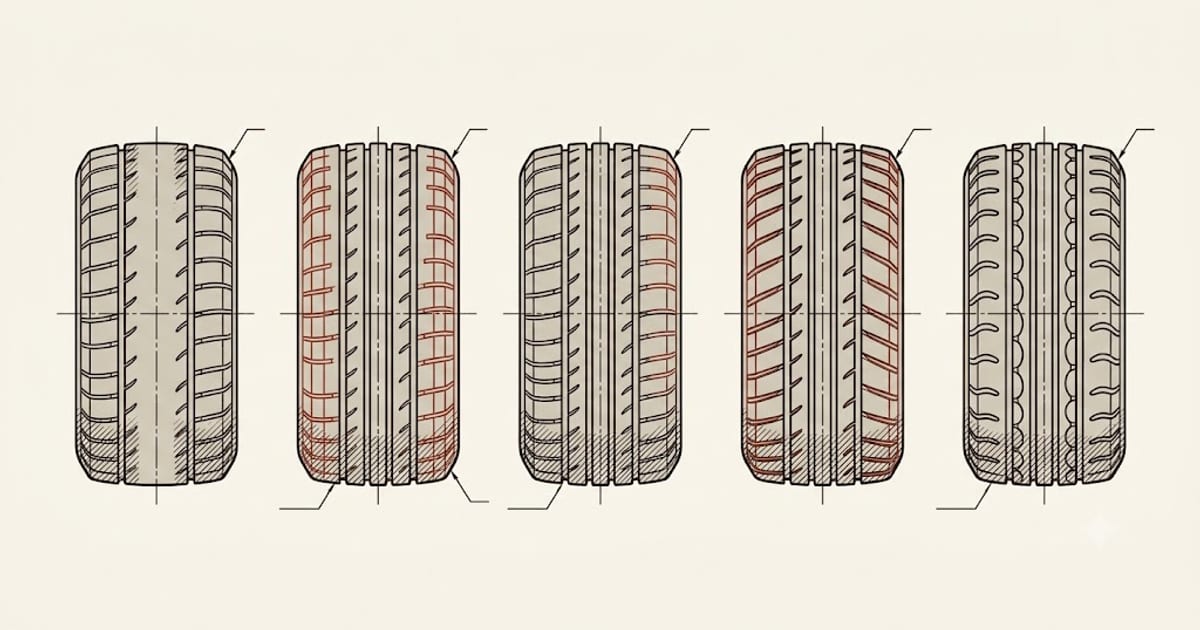
Tread wears where load and slip concentrate. That makes the wear pattern a readable record.
1. Centre worn, edges good — overinflation
Too much pressure crowns the tread so the middle carries the load. Grip falls, ride harshness rises, and the tire wears out early through a strip in the middle.
Check against the door placard, not the maximum on the sidewall. That maximum is the tire's limit, not a recommendation, and treating it as one is the single most common cause of this pattern.
2. Both edges worn, centre good — underinflation
The tread collapses in the middle so the shoulders carry the load. Rolling resistance rises, the sidewall flexes and heats, and in the worst case the tire fails structurally.
This is the more dangerous of the two, and it develops slowly enough to go unnoticed. Check pressures cold, monthly.
3. One edge worn — camber, or toe
Wear on the inside or outside shoulder only is an alignment fault.
Camber — the wheel leans, so one shoulder carries more load. Often from a sagging spring or a bent component after a kerb strike.
Toe — the wheel points slightly in or out, so the tire scrubs sideways as it rolls. Toe wear usually comes with feathering (below).
Either way it is an alignment, and replacing the tires without fixing it just buys the same pattern again.
4. Feathering — toe misalignment
Run a hand across the tread. If it feels smooth one way and sharp the other, each tread block is worn at an angle: the tire is being dragged sideways as it rolls.
This is almost always toe, and it is one of the fastest ways to destroy a set of tires. It is also nearly invisible to the eye.
5. Cupping or scalloping — suspension
Regular scalloped dips around the circumference. The tire is bouncing rather than rolling, so it loses contact and lands repeatedly at the same interval.
Causes: worn shock absorbers, worn ball joints or bushings, or a badly out-of-balance wheel. Cupping is a suspension diagnosis, not a tire one, and new tires on the same suspension will cup again.
Rotation
Front and rear tires wear differently — the front does the steering and, on most cars, the driving and most of the braking. Rotating every 5,000 to 8,000 miles evens that out and typically adds 20% to set life.
Patterns depend on the tire: front-wheel drive is usually forward-cross, rear-wheel drive rearward-cross. Directional tires rotate front to back on the same side only. Staggered or asymmetric-with-different-sizes setups often cannot be rotated at all.
Depth
2/32 in is the legal minimum in most of the US and it is far past useful. Wet stopping distance degrades sharply below 4/32, and for snow the practical limit is closer to 6/32.
The penny test finds 2/32. A quarter finds 4/32, which is the number worth watching.