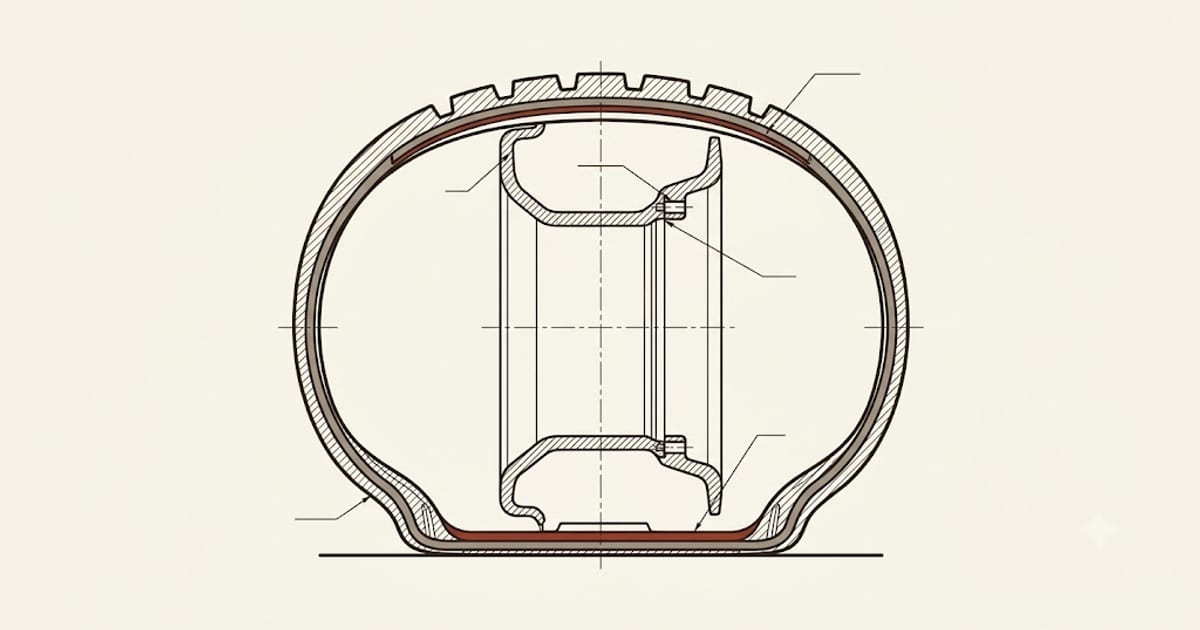
Two circumferences describe a tire and they are not the same number.
Geometric circumference = π × overall diameter. What the size code implies.
Rolling circumference = the distance actually covered in one revolution under load. Typically 3 to 4% less, and it is the figure that governs everything the vehicle measures.
Why loaded is different
Under load the tire deflects, so the axle sits lower than the unloaded radius. That squashed radius is the loaded radius — and it is noticeably smaller.
But the tire does not travel 2π × loaded radius. The tread belt is a steel-reinforced band that does not stretch or shrink; it flattens against the road rather than shortening. So the distance per revolution stays close to the free circumference, and only a few percent is lost to the sidewall flexing into and out of the contact patch.
That gap between "how low the axle sits" and "how far it travels" is the part that confuses people, and it is why you cannot derive rolling circumference from a ride-height measurement.
Which figure goes where
Speedometer and odometer calibration — rolling circumference. Manufacturers publish revolutions per mile for each size, and that is the authoritative number.
Clearance checks — unloaded overall diameter, because clearance is worst when the suspension unloads.
Gear ratio calculations — rolling circumference, since it decides engine rpm at a given road speed.
Speedometer error between two sizes — either, as long as you use the same one for both. The error is a ratio, so the 3 to 4% loss cancels.
That last point is why the simple diameter comparison works fine for the question people usually ask.
Revolutions per mile
The cleanest published figure, and the one to compare when swapping sizes:
revs per mile = 63,360 ÷ rolling circumference in inches
A 225/45R17 at about 24.9 in diameter has a rolling circumference near 75.6 in, so roughly 838 revolutions per mile.
Tire manufacturers list this per size, and where two sizes have similar revs per mile, they are genuinely interchangeable for calibration purposes even if their nominal diameters differ slightly.
What changes it
Pressure — lower pressure means more deflection and slightly fewer inches per revolution.
Load — the same effect. A heavily loaded vehicle reads marginally optimistic on the odometer.
Speed — at high speed centrifugal force expands the tire slightly, increasing rolling circumference.
Wear — a worn tire is smaller. Between new and 2/32 the diameter drops about half an inch, which is roughly 1.5 to 2% on a passenger tire and a real, gradual speedometer drift over the life of a set.