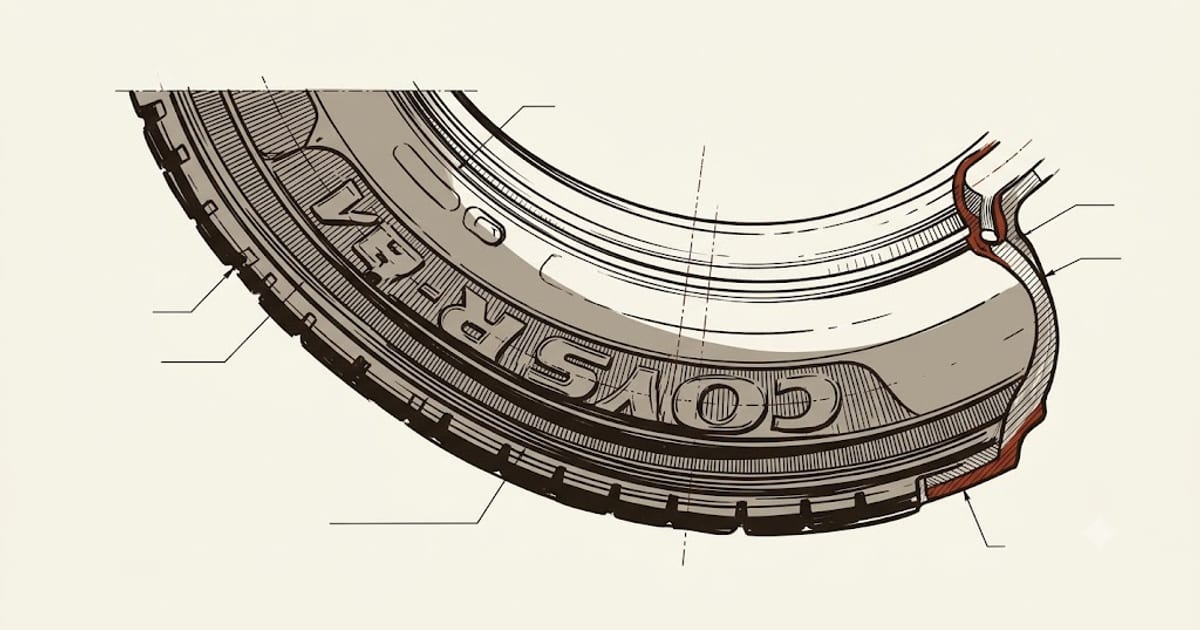
The size code
225/45R17 94V
- 225 — section width in mm, at the widest point of the sidewall
- 45 — aspect ratio: sidewall height as a percentage of section width, so 101 mm here
- R — radial construction
- 17 — rim diameter in inches
- 94 — load index (1,477 lb per tire)
- V — speed rating (149 mph)
Overall diameter is the rim plus two sidewalls: 17 + 2 × (101 ÷ 25.4) = 24.9 in.
A leading P means P-metric, a passenger-car standard. LT means light truck: higher load capacity, stiffer construction, harder ride. No letter usually means Euro-metric, which carries slightly more than the same P-metric size.
The DOT code — read this one first
Ends in four digits: the week and year of manufacture. 3223 means week 32 of 2023.
Rubber ages whether or not the tire is used. Most manufacturers recommend replacement at 6 to 10 years regardless of tread depth, and many vehicle makers say 6.
"New" tires sold from old stock are common, and the date code is the only way to know. A tire made four years ago has already used a large part of its calendar life on a warehouse shelf.
UTQG: treadwear, traction, temperature
Treadwear — a relative number, where 100 is a reference tire. A 600 tire should last roughly twice a 300 tire. The number is self-assigned by each manufacturer against their own reference, so it compares within a brand and only loosely between brands.
Traction — AA, A, B, C. Wet straight-line braking on specified surfaces. Not cornering grip.
Temperature — A, B, C. Heat dissipation at speed.
Winter markings
M+S is a tread-pattern description. Any tire with a certain void ratio can carry it, and most all-season tires do. It is close to meaningless as a snow claim.
3PMSF — the three-peak mountain snowflake — requires passing a standardised snow traction test. It is the marking that means something, and in some jurisdictions it is the one that satisfies winter tire laws.
Other markings worth knowing
- Max load / max pressure — the tire's own limits, not the recommended pressure. Use the door placard for that.
- Treadwear indicator bars in the grooves, level with 2/32 in of tread. Legal minimum in most of the US, and well past the point where wet performance has gone.
- Rotation arrow on directional tires. Fitting one backwards costs wet performance and makes it noisy.
- Inside / Outside on asymmetric tires.
- Extra Load / XL — higher load index at higher pressure.
Convert any size to real dimensions on the tire size calculator — the arithmetic is simple and the errors people make are all in the same place: forgetting the aspect ratio is a percentage of the width, not a measurement.